Blog
Get Pay Right on ADP Workforce Now® Next Gen™
Bringing trusted compensation intelligence and seamless planning to even more ADP users.
Written by Salary.com Staff
July 04, 2025

Creating a bonus program that works for employees is crucial to increasing employee motivation, boosting productivity, and integrating individual success with company objectives. Well-designed employee incentive programs have been repeatedly shown to result in notable performance improvements.
A study indicated that employee incentive programs work and can raise performance by as much as 44%, particularly when implemented over an extended period.
This guide provides a step-by-step process on how to make an employee bonus plan, including its definition and different types.
A structured compensation plan, known as an employee bonus program, provides financial rewards to incentivize employees for their accomplishments—whether as individual employees, as a team, or across the company. These bonus structures are designed to boost employee engagement, align employee performance with organizational success, and motivate employees to reach shared goals.
The U. S. Office of Personnel Management (OPM) highlights that bonus payments, such as performance bonuses, retention bonuses, or signing bonuses, can improve employee satisfaction, increase job satisfaction, and raise employee morale when applied fairly and communicated transparently.
According to a study , incentive programs centered around groups like gainsharing foster collaboration and active participation while also helping to achieve sales targets and increase company profits. An effective bonus program is not only a motivational tool but also a key component in driving financial success and ensuring employee success within a well-defined incentive plan.
Companies need agile incentive compensation software to seamlessly manage complex employee bonus plans. This flexibility empowers business leaders to design and implement employee incentive programs that drive performance and align with evolving organizational goals.
Employee bonuses come in several forms, each serving different strategic purposes within an organization. Here are some types of employee bonuses:
Performance-based bonuses
Performance incentives are given by employers in accordance with quantifiable key performance indicators and overall objective progress. While the majority of performance bonuses are given to individuals, some highly collaborative organizations would rather give team bonuses based on team performance.
Retention bonuses
Employees are encouraged to remain with a company during critical circumstances, like mergers or changes in leadership, by offering retention bonuses. Retention incentives are instruments to keep high-performing or mission-critical employees from leaving the company.
Recruitment bonuses
These incentives are provided to attract applicants who possess difficult-to-find skills or credentials. The OPM indicates that recruitment bonuses are particularly helpful for hard-to-fill positions or in competitive labor markets.
Gainsharing bonuses
Giving employees a share of the company's profits in exchange for better performance is known as a profit-sharing bonus. According to a study, gainsharing schemes encourage employees to collaborate and increase efficiency.
Spot bonuses
Spot awards are presented spontaneously in recognition of outstanding individual behaviors or efforts that surpass expectations. Positive behavior is immediately reinforced by these employee rewards, which are frequently simple but instant, such as cash bonuses.
Sign-on bonuses
Sign-on bonuses are given to new hires as a perk for accepting a job offer; they are different from recruitment bonuses. These are frequently employed in competitive industries. OPM discusses that sign-on bonuses are frequently utilized when other benefits or salary offerings are limited and can aid agencies in competing for limited talent.
Holiday bonuses and annual bonuses
These periodic incentives, often based on company performance or employee tenure, serve to maintain morale and demonstrate appreciation. Holiday and annual bonuses contribute to employee preferences for recognition and ensure that employees feel valued for their ongoing contributions.
Referral bonuses
Companies use referral bonuses to encourage employees to recommend potential candidates for open positions, helping reduce hiring costs and increase cultural fit with existing employees.
Employee incentive programs, when designed and implemented effectively, reward employees and offer a wide range of benefits. These benefits extend beyond individual motivation and can positively impact overall organizational performance, engagement, and retention.
Increased employee performance and productivity
It has been demonstrated that employee bonus programs greatly increase worker productivity. A study discussed that well-designed incentive programs could increase performance by up to 44%, particularly when they are in line with long-term objectives.
Improved employee retention
By fostering a sense of worth and reward, retention bonuses and performance incentives help lower employee turnover. OPM highlights that retention incentives are essential for retaining key workers, especially in high-demand professions or during organizational transformations.
Encouragement of team collaboration
Team bonuses for teams or groups encourage employees to cooperate and lessen damaging competition among coworkers. According to a report, group-based incentives improve overall cohesiveness by coordinating team efforts and encouraging a sense of shared accountability for results.
Attraction of top talent
Bonuses for signing up and recruiting, including referral bonuses, are useful strategies for drawing in highly qualified applicants, especially in sectors with high levels of competition. OPM emphasizes how beneficial these incentives are for resolving significant skills gaps in government agencies and filling hard-to-recruit positions.
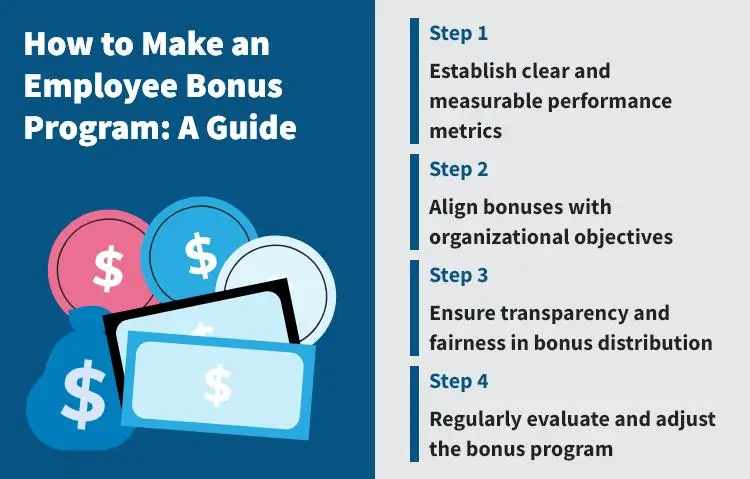
When workers know exactly what is expected of them and how their efforts are assessed, employee incentive programs work effectively. For a performance-based pay system to be successful, performance metrics need to be clear, attainable, and closely related to job duties. Uncertain or conflicting standards might lower employee motivation and give the impression that a situation is unfair. Additionally, these metrics should be regularly communicated and integrated into performance appraisals to reinforce their relevance and legitimacy.
Bonus programs should encourage employees to take actions and produce results that lead to success while supporting the organization's overall mission and strategic objectives. Research found that matching incentives to organizational goals increases employee loyalty and participation in addition to performance. Employers make sure that bonus structures encourage significant and quantifiable achievements by coordinating them with strategic goals.
Bonus programs are more inclined to be accepted by workers when the procedures and criteria are seen as fair and uniformly implemented. Accordingly, building confidence in bonus systems and avoiding adverse effects like favoritism or disengagement need transparency. Transparency entails being clear about who is eligible, how decisions are made, and how bonuses are decided. Research demonstrates that fair group and individual bonus implementation boosts morale and cooperation. In some cases, companies may also provide discretionary bonuses as a way to recognize exceptional performance outside standard parameters.
To build trust and transparency around employee bonus programs and benefits, companies must clearly communicate the full scope of compensation. Simplifying employee benefits helps incentivize employees and boost employee motivation by ensuring they understand and appreciate the financial rewards they receive, including monetary rewards.
Incentive programs should adapt to changing economic situations, employee preferences, and organizational needs. To make sure that financial rewards continue to promote desirable behaviors and results, the OPM recommends organizations evaluate their outcomes regularly. Employers can optimize the system's impact by improving it with the use of employee feedback and performance statistics.

The latest research, expert advice, and compensation best practices all in one place.
Blog
Bringing trusted compensation intelligence and seamless planning to even more ADP users.

Blog
Learn how to train managers for effective pay conversations and build trust.

Blog
Total rewards package flexibility lets employees choose what matters - pay, perks, and benefits tailored to their needs.