Blog
Get Pay Right on ADP Workforce Now® Next Gen™
Bringing trusted compensation intelligence and seamless planning to even more ADP users.
Written by Salary.com Staff
July 18, 2025

Managing compensation in an efficient and effective manner should always be considered before everything else. Although there are no concrete numbers available on the internet, it’s still properly inferred that most small to medium-sized companies still lack proper salary management systems in their name.
Thus, having a proper compensation administration system is key to having a more functional rewards system to ensure that everyone within the company can be paid at a fair price, come up with better pay decisions moving forward to attract and retain top talent, and help align the compensation practice with the business goals.
Read on to learn more about proper compensation administration, what it is and how it works, the benefits that it can bring to companies, as well as the steps on how to create one moving forward.
Compensation administration is a practice that HR professionals use to ensure pay equity among employees and help align a company's goals. This includes properly administering everything from a compensation standpoint— from designing a proper compensation strategy to proper administration of salaries and bonuses.
The salary administration process is designed to aid internal equity practices since it puts a company’s compensation practices into perspective for them and allows for better human resource management in the long run.
Since the salary management process deals with a company’s compensation practices, it’s highly suggested for companies to use reliable compensation planning software to help alleviate the stress that usually comes with it in the long run.
Since salary administration covers a wide array of topics, listed below are some examples that companies can try out to ensure a smoother compensation administration process moving forward. It can be sorted into two categories: direct and indirect compensation.
Direct compensation: Direct compensation is monetary compensation that an employee will receive for doing their current job descriptions. The most notable examples are listed below.
Salary structure
Bonus programs
Indirect compensation: Indirect compensation, on the other hand, deals with non-monetary forms of compensation that companies can tack on to their compensation structure. Some notable examples of these are listed below.
Health insurance
Retirement plans
The most notable benefit of proper salary management is employee retention. Employees that are paid well are more likely to be productive than those who are not. This is because at a base level, having a good salary administration allows managers to pay their employees competitively— if not better in most cases.
This creates a domino effect, as productive employees also mean a lower turnover rate and can help align their performance to the business’ overall goals moving forward as well. This effectively translates to a higher retention rate and a better chance for the company to succeed.
Before creating a compensation administration process, it’s important to consider the key components listed below.
Market trends: Proper knowledge of market trends should be considered before creating a salary administration process. Knowledge of how much a certain job description is paid by others in the market can help companies set a more competitive benchmark to set them apart from others and can even help boost employee satisfaction.
Though there are plenty of ways to do so, most companies can alleviate the initial stress of the salary management process by using tools like Salary.com’s CompAnalyst to properly acquire data they need to get a more competitive compensation package.
Internal equity: Internal equity refers to the process of compensating employees at a similar level to individuals with the same job grades. Most companies should properly consider internal equity beforehand to ensure that everyone can benefit from it.
Financial resources: Lastly, companies should consider their financial resources before creating a compensation package for their employees. Paying employees too much can put the company in a treacherous position, whereas paying them too little can mean that the vast majority of employees will be leaving.
Listed below are the steps that companies can take to create their own compensation administration process.
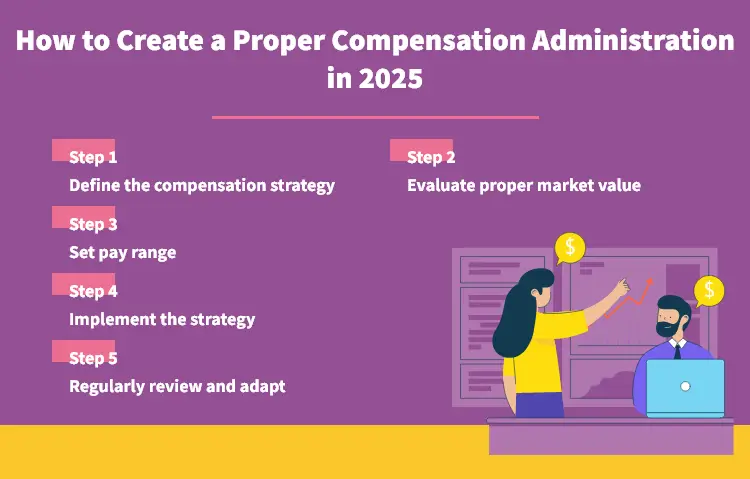
The first step when creating a salary administration process is to figure out the salary structure that the company will use. Not all companies can take advantage of the regular 9-5 model, and not every employee can follow variable pay programs instead.
Thus, it’s highly suggested for companies to properly weigh out the pros and cons of the different types of compensation and formulate the annual increases for each type to ensure that every employee can function as best as they can while ensuring that they can reach the company’s goals.
For this step, it’s highly suggested to use reliable compensation planning software to ensure that the process goes smoothly and is up to industry standards. With the right tool, companies can even properly map out their bonus packages and rewards systems.
Organizations should also ensure that the chosen compensation strategy is legal and follows the regulations of the state the business is in.
Afterwards, companies should conduct a proper job analysis of an employee's market value and learn the pay scales for similar roles within the area. After acquiring this, companies can then either match or price their role higher to entice new employees to join their company.
As mentioned above, Salary.com’s CompAnalyst can help play a crucial role for companies as it can help companies determine a competitive price range for a specific role within the area. The tool is also relatively easy to use and delivers instantaneous results, essentially ensuring quick decision-making for the company.
Next, companies should set the pay range that they’ve chosen. For this step, it’s important to consider the compensation tiers that the company will implement for a specific job title. The tiering would determine how much an employee’s salary will go up depending on certain factors like market conditions, promotions, performance, and the overall employee journey.
One of the most straightforward steps within the framework, the penultimate step in implementing the compensation administration process, is to implement the compensation strategy that the company has chosen. This can be done by using proper communication channels like sending a company-wide email fully detailing the compensation plan or holding a company meeting regarding the change in compensation strategy.
Finally, companies should regularly review the compensation program that they’ve chosen and continuously adapt it to their current needs. There are plenty of factors like job duties, job evaluation, performance evaluations, responsibilities and contributions, pay increases, pay changes, and merit increases that may affect the plan’s overall success, and properly adapting to these factors can result in a more successful incentive strategy.

The latest research, expert advice, and compensation best practices all in one place.
Blog
Bringing trusted compensation intelligence and seamless planning to even more ADP users.

Blog
Learn how to train managers for effective pay conversations and build trust.

Blog
Total rewards package flexibility lets employees choose what matters - pay, perks, and benefits tailored to their needs.