Blog
Get Pay Right on ADP Workforce Now® Next Gen™
Bringing trusted compensation intelligence and seamless planning to even more ADP users.
Written by Salary.com Staff
June 13, 2025

At a base level, companies should know how to properly manage their talents and employees to make sure that they’re perfectly aligned with the company’s goals. Talented employees provide excellent service – and excellent service produces successful companies.
To do that, companies can create performance management systems to alleviate their problems. Not only can it help companies align their employee performance with their current needs, but the right framework can be a relatively cost-effective solution as well.
Continue reading this article to learn more about performance management framework, some examples that companies can use, along with a guide on how to create an effective performance management system for their company.
Performance management framework is the method that companies can take to track employee progress for better organizational success. This also includes providing feedback, rewarding positive efforts, and correcting employee performance to help reach the level that the company wants them to be at.
Essentially, these frameworks allow companies to align company goals with employee goals to ensure career growth while helping identify areas where improvement may be needed.
Though most companies already have a basic framework setup, having a more in-depth one to replace it can help bring out the most out of employees. After all, research has shown that 33% would like to receive continuous feedback.
Consultants provide a better insight into providing performance management frameworks for companies, especially when it comes to revamping their performance framework. Additionally, the right consultant can even provide valuable insights on what the company lacks, effectively killing two birds with one stone.
Performance management framework can help drive results by setting clear expectations for every employee out there. This, in turn, can help with their overall career development in the long run.
An easily adaptable framework also allows companies to properly adapt to external changes that may occur. This has become a lot more important nowadays, thanks to the internet making an already fast-paced industry like business become significantly faster.
The 5 Cs of performance management which are the cornerstone of a robust performance management framework and is listed below:
Clarity
Context
Consistency
Courage
Commitment
These are the 5 cornerstones of a successful framework and can help companies manage their talent better. Providing employees with clarity and context can help them understand their workload better, being consistent can help save time clarifying everything, an encouraging leader can help motivate them towards the company’s goals and provide them with the commitment they need to perform better.
Listed below are some examples of performance management frameworks for companies willing to start their framework management program.
Performance appraisal template
One of the most consistent ways to track performance management, the performance appraisal template is often administered quarterly instead of the standard annual reviews. This ensures regular feedback, and lets them discuss everything from performance, challenges, and what needs to be improved in frequent meetings instead of an annual performance review.
Project evaluation
Though regularly reserved for project-specific scenarios, project evaluation directly evaluates teamwork effectiveness for the duration of said project. This can be done either weekly or biweekly – depending on what the companies see fit.
Management by objective
Management by objectives (MBO) is a type of framework that can help companies improve their workflow by using objectives instead of metrics to reach their goals and measure progress. This provides them with a balanced scorecard approach to tracking employee growth and ensures that
Numerical performance review
The numerical performance review is a more straightforward template that lets employees rate a statement from a scale of 1 to 5 for more measurable key results. These questions can then help employers find potential gaps in their performance framework, which can then help them adjust accordingly through the use of performance data.
Consultants can help guide companies with the statements since these questions can be difficult to navigate, especially when it comes to newer companies.
Peer review
Peer reviews offer a more nuanced take on corporate performance management as the employees provide the feedback instead of the employers for a certain performance cycle. These can then provide companies with unique, nuanced insights that they might have missed in their initial review.
Below are the steps that companies can take to create an effective, future-proof framework for their employees.
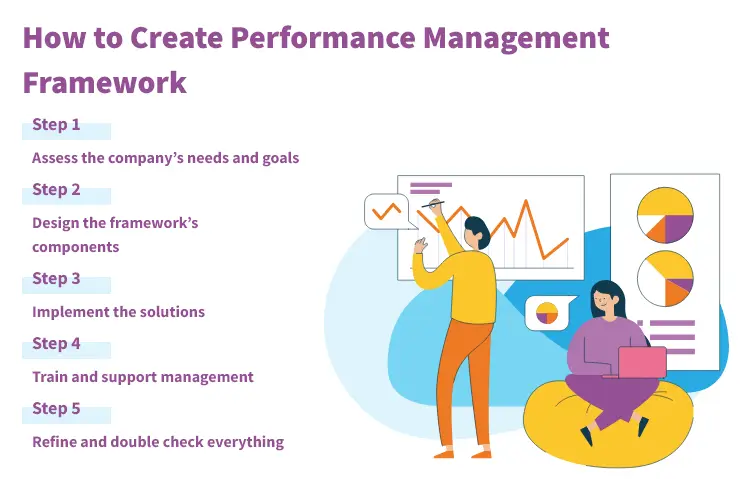
Understanding the company’s needs and goals is the first step to creating their own framework. It’s also important to consider the employees’ current individual performance level and how much they fit in with the workplace. For this step, it’s important to consider that one company is different from another – thus, the needs of big conglomerates like Google aren’t necessarily what a medium-sized company will be needing at the moment.
Executing this step well means creating a more robust backbone for the framework. And having a more robust backbone, in turn, can help companies save time, money, and resources in the long run.
The next step is to design the framework based on step number one. Organizations can choose either the aforementioned examples of performance framework, or other examples that better suit one company.
It’s important to consider that as the first step, one specific performance framework does not necessarily work for every company. It’s important to design the framework around every employee’s preexisting skill set to achieve performance goals.
For what it’s worth, consultants can help provide useful insights on how to design the framework to ensure that it will be a resounding success. Not only that, but certain consultants can even provide help when it comes to staffing issues, which can help companies move forward.
After everything has been decided, the next step is to implement the performance framework that the company has chosen. There are plenty of ways to implement this, like sending company-wide emails properly detailing the implementation of the framework.
However, just because the solution has been chosen and implemented does not mean that it can’t be changed. If it doesn’t work, then forcing it to work can do more harm than good. Do not hesitate to change it after a month or two – trial and error is part of the business.
Before wrapping up, it’s important to train the management team and provide them with the resources to help them with the implementation of the framework. This allows them to build trust with the employees directly under them, which can then help them meet their goals.
However, it’s important to consider that everyone needs to be supported when it comes to the implementation of the new performance framework to ensure that the transition goes smoothly.
Consultants can provide a better insight into the entire management support system. Think of consultants as the guide to the leaders – consultants can provide leaders with the right mindset to properly lead amidst the big change that will be coming to the company with the help of the performance framework.
After everything’s been implemented, the last step to create an effective performance management framework is to refine and double-check everything. This is to ensure that there are no grey areas and everyone participating can improve their numbers within the company – guaranteeing employee satisfaction in the process.
Additionally, consistently refining the development programs allows for companies to forego the trial-and-error process and allows them to keep their current performance management system. This can help them save more money in the long run, help with overall goal setting, on top of providing them with a performance framework that’s uniquely theirs.
There are plenty of ways that contribute to performance management system failing. From poor communication, unclear organizational objectives, and failing to align the framework to their overall company culture, there's plenty of pitfalls that companies can fall into if they're unprepared.
Thus, using performance management software to streamline the entire performance management process can not only boost organizational performance, but also help provide continuous improvement to every employee involved. Think of performance management framework as a means to and end - a way to achieve organizational goals through the use of a system that helps collect data points to provide constructive feedback and help provide the right tools to every employee.

The latest research, expert advice, and compensation best practices all in one place.
Blog
Bringing trusted compensation intelligence and seamless planning to even more ADP users.

Blog
Learn how to train managers for effective pay conversations and build trust.

Blog
Total rewards package flexibility lets employees choose what matters - pay, perks, and benefits tailored to their needs.