

Blog
Get Pay Right on ADP Workforce Now® Next Gen™
Bringing trusted compensation intelligence and seamless planning to even more ADP users.
Written by Salary.com Staff
November 29, 2023

Incentive pay is an additional wage or salary payment given to employees over and above their base pay. The purpose of incentive pay is to encourage workers to put in more effort or accomplish particular objectives. It may come in profit-sharing payments, individual bonuses, or group bonuses. Employees who reach or surpass predetermined performance targets are rewarded through performance-based pay schemes, frequently combined with incentive compensation.
To retain key staff, you may offer incentive pay to your senior management team or to your sales team when they reach specific milestones. To increase output and overall morale, you might think about providing all employees with incentive pay to all employees. However, if you do that, you'll need to decide under what conditions incentive pay will be granted.
An incentive pay plan must be carefully considered before being established in order to be rewarding and provide recognition. If sufficient transparency and thorough thinking are lacking, this kind of program may is a possibility that this kind of program will be demoralizing and polarizing.
Applying the SMART system (specific, measurable, achievable, realistic, and time-limited) is a fantastic idea to use the SMART method (specific, measurable, attainable, practical, and time-limited) when developing an incentive pay plan.
Long-term and short-term incentive pay are two different forms of compensation that are used to incentivize employees based on different time horizons and goals.
Short-term incentive compensation is typically designed to reward immediate or near-term performance achievements. These incentives are tied to specific, short-term goals, such as quarterly or annual targets. Short-term incentive pay is often used to motivate and reward employees for meeting or exceeding performance expectations within a relatively short timeframe.
Examples of short-term incentives include performance bonuses, sales commissions, or other forms of variable pay that are directly tied to individual or team performance over a specific period. These incentives provide immediate financial rewards and are often based on quantitative metrics or key performance indicators (KPIs) that align with the organization's short-term objectives.
Long-term incentives are designed to align employee interests with the long-term success and sustainability of the organization. These incentives focus on rewarding employees for contributing to the company's growth, profitability, or other strategic objectives over an extended period.
Common long-term incentives include stock options, equity grants, or profit-sharing programs where employees receive a share of the company's profits or gains over time. These incentives aim to provide employees with a sense of ownership and an opportunity to benefit from the company's long-term success.
Long-term incentives often have vesting periods, meaning that employees must remain with the organization for a certain period before they are eligible to fully realize the benefits. This helps promote employee retention and long-term commitment to the organization's goals.
Both short-term and long-term incentive pay can be used in combination to provide a comprehensive compensation package that motivates employees in the short term while aligning their interests with the long-term success of the organization. The specific mix of short-term and long-term incentives will depend on the industry, organizational goals, and the desired balance between immediate performance and sustained growth.
To effectively use incentive pay, it is important to develop a well-designed program that aligns with your organization's goals and motivates employees to perform at their best. Here are some steps to consider when implementing an incentive pay system:
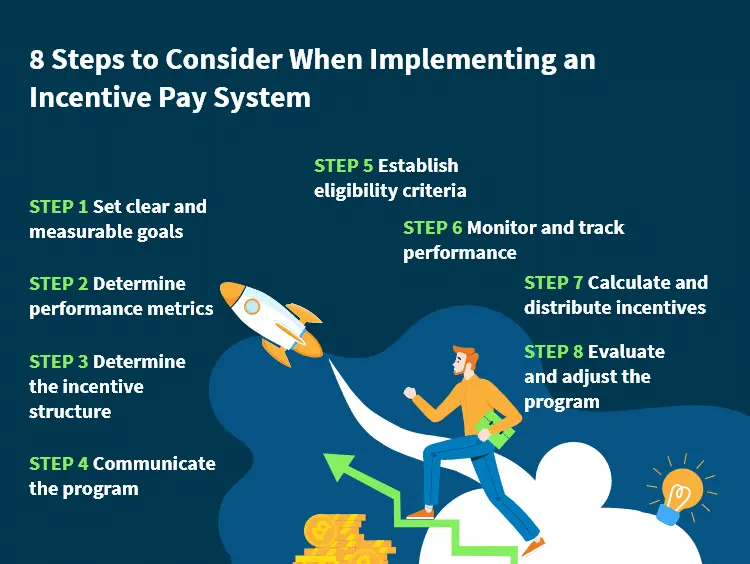
Remember, the success of an incentive compensation program depends on its design, communication, fairness, and alignment with organizational goals. Regularly review and adapt the program to ensure it continues to drive desired employee behavior and performance.
Indeed, incentive pay is adequate, mainly when a perceived lack of benefits exists. It is more likely to be seen as guaranteed pay if incentive pay is consistently provided.
The advantages of incentive compensation can help you to grasp better why.
A well-thought-out incentive compensation plan should advance both your company and its workforce. Pay incentives:
All of the aforementioned factors lead to an enhanced customer experience and a better product or service. Ultimately, these gains in productivity and efficiency translate into real top-and bottom-line growth.
Merit-based pay is what incentive pay is. It can take the shape of monetary or non-monetary awards and is typically linked to performance or reaching predetermined goals.

The latest research, expert advice, and compensation best practices all in one place.
Blog
Bringing trusted compensation intelligence and seamless planning to even more ADP users.

Blog
Learn how to train managers for effective pay conversations and build trust.

Blog
Total rewards package flexibility lets employees choose what matters - pay, perks, and benefits tailored to their needs.
