Blog
Get Pay Right on ADP Workforce Now® Next Gen™
Bringing trusted compensation intelligence and seamless planning to even more ADP users.
Written by Salary.com Staff
June 20, 2025

Companies have different approaches in how they manage performance of teams and employees.
Auto-audit pay gaps. Eliminate bias before it strikes.
Research suggests that some of the leading priorities of HR leaders in performance management are frequent feedback and regular communication between workers and managers.
Whether it be an organizational or individual performance, using the agile system is one way to embody these priorities, achieve team objectives, track progress, and identify future development for organizational success.
To gain more insights about the agile approach in performance management, read on as we discuss its elements, distinction from the traditional system, its benefits and examples, best practices, and how to implement an agile strategy.
Agile performance management, or continuous performance management, is a strategy that focuses on collaboration and continuous improvement in the organization. This performance management approach promotes frequent check-ins, constant learning, and building trust and connections.
Contrary to the traditional performance management process, which practices rigid annual reviews, the agile way of evaluation is through timely feedback that encourages more employee engagement and cooperation.
Since performance management also involves pay raises for commendable employees, ensuring an equitable salary increase is a must. This is easier to achieve with a Pay Equity tool, which helps companies identify pay gaps, benchmark market pricing, and promote pay transparency in company culture.
Continuous performance management focuses on employee and organizational development. To effectively do this, it has important elements that keep its performance objectives in check. Here are the elements of the agile performance management model:
Frequent performance check-ins
Ongoing development conversations between team leaders and members help in keeping track of people’s performance, opportunities for growth, and strategies that enable progress. This builds trust, connection, and alignment of goals within the team.
Multiple-sourced feedback
Feedback in agile performance management system comes from multiple individuals other than the employee’s direct manager. For the inputs to be well-rounded and holistic, feedback can come from peers, customers, and subordinates.
Employee centricity
Agile management prioritizes employees. It provides transparent communication, constructive evaluation, and growth opportunities. These agile practices empower and value the workforce through learning and development.
Skill-based development
Managers in agile organizations become performance coaches for the employees. Aside from giving assessments and performance reviews, they also ensure that the team experiences skill development and career growth.
Focus on organizational goals
In an agile approach, annuals goals become smaller increments, making the objectives more achievable. Collaboration is involved in setting goals, ensuring that the aim of individual employees and the overall team is aligned with the company vision.
While agility has a more adaptable approach, traditional performance reviews have a more rigid and bureaucratic method. Here are ways a traditional performance management differ from an agile one:
| Traditional | Agile | |
|---|---|---|
| Frequency | Annual employee evaluations; often with mid-year performance reviews. | Continuous feedback process and regular check-ins by monthly, biweekly, or weekly. |
| Aim | The focus is on the past performance data, such as evaluations on projects a year ago or a team performance in handling a situation from months ago. | The focus is the present and the future organizational performances to address potential issues proactively, such as discussing recent projects. |
| Leadership | Managers are direct with annual performance reviews. They tell employees the areas for improvement and ask standard questions with limited mention of growth opportunities. | Managers serve as performance coaches for employees, giving them key points for improvement, developing workers for future roles, and collaborating in decision-making. |
| Sources | The source of feedback comes from the manager only. | The sources of feedback come from multiple people besides managers: peers, clients, subordinates. |
Just like the continuous feedback in an agile environment, regular updates on job structures and market pricing during performance reviews is a better approach in performance management and pay practices. Tools like Continuous Pay Analysis can help you achieve this approach.
Due to the dynamic and real-time approach of an agile work environment, there are advantages that organizations gain from it. Here are the benefits of adopting agility in your performance management:
Increases adaptability: Due to regular check-ins and incremental goals, the company can adjust with the shifting demands of the market with a responsive workforce.
Enhances employee engagement: Frequent feedback helps employees feel valued and motivated to work, which boosts their commitment and involvement in the company.
Develops employee skills: The management is focused on the professional development of the employees, leading to versatile and competitive skillsets.
Minimizes biases: Performance evaluations are fairer than annual reviews since there are more frequent and recent observations of an employee’s work behavior.
Achieves goal alignment: Team efforts and priorities are consistently aligned with business goals as objectives are more short-term and flexible.
To give you an overview of the real-life implementation of an effective agile performance management process, here are 3 examples of companies that adopted this approach:
Philips: This company aimed to improve their efficiency, quality, and alignment by organizing agile teams that have separate work and coordination. This helps the company lessen its release cycle from 18 months to 6 months.
Toyota: The company provides formal training to emulate continuous improvement in its employees and organization. They focused on aligning product delivery with the growing customer needs alongside waste reduction.
JPMorgan: They promoted collaboration of employees with different expertise to efficiently innovate products. Large projects were also broken down into smaller ones, work cycles were reduced, and customer feedback was implemented.
Transitioning to an agile environment does not happen overnight. It needs to follow specific steps to effectively promote collaboration and continuous improvement in the organization. Here is how you can implement continuous performance management:
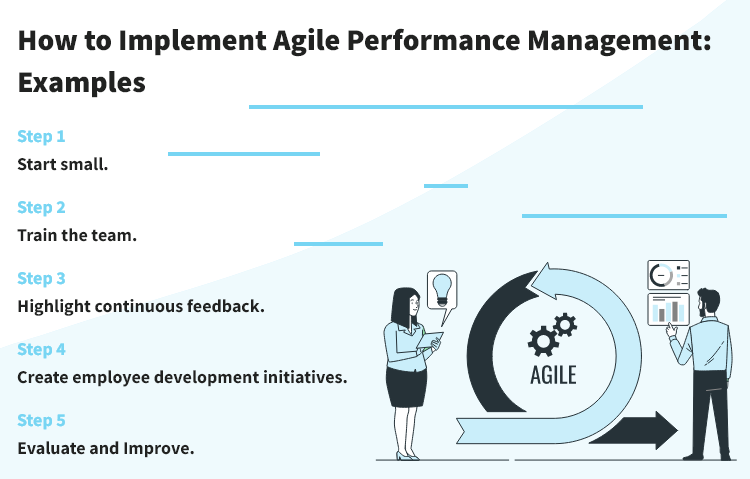
Before establishing a full-blown agility, start by applying the performance management to a team first within a period. Gather the performance results and constructive feedback, then assess its feasibility and areas of improvement.
Integrate the approach into individual employees and managers. To fully embody the agile system, they must have the proper mindset and skills when it comes to setting performance goals, promoting development, how to provide feedback, and how to receive them.
Train managers in the importance of regular check-ins and feedback in improving employee engagement and performance. Give examples and resources to help them capture the essence of real-time conversation and encourage multiple sources when it comes to feedback.
Establish learning and development programs to help employees achieve improvement and satisfaction in their skills and competencies. Guide them in their respective career paths so they have a clear understanding of their skills gaps or potential roles in the future.
Since agile principles are about continuous improvement, always evaluate the progress and success of the system to maintain its efficiency and adjust strategies to improve its implementation.
To build and maintain an agile management, there are best performance management practices a company must use. Here are some of them:
One-click compliance reports for state pay equity laws.
Establish clear expectations: To align the team’s effort with the company goals, communicate and make employees understand business priorities and expectations.
Leverage technology: Use agile management tools to streamline agile processes, set goals, simplify gathering feedback, and boosting collaboration.
Reward performance: To encourage achievements and continuous improvement, promote recognition and reward programs for the employees.
Ultimately, one the best ways to gain trust and connection in agile strategy is to assess pay gaps existing alongside salary adjustments from performance evaluations. Through the Pay Equity tool, use employee performance as an important variable in identifying pay disparities and implementing fair payments for employees.

The latest research, expert advice, and compensation best practices all in one place.
Blog
Bringing trusted compensation intelligence and seamless planning to even more ADP users.

Blog
Learn how to train managers for effective pay conversations and build trust.

Blog
Total rewards package flexibility lets employees choose what matters - pay, perks, and benefits tailored to their needs.