How to Measure Organizational Health: Metrics & Definition

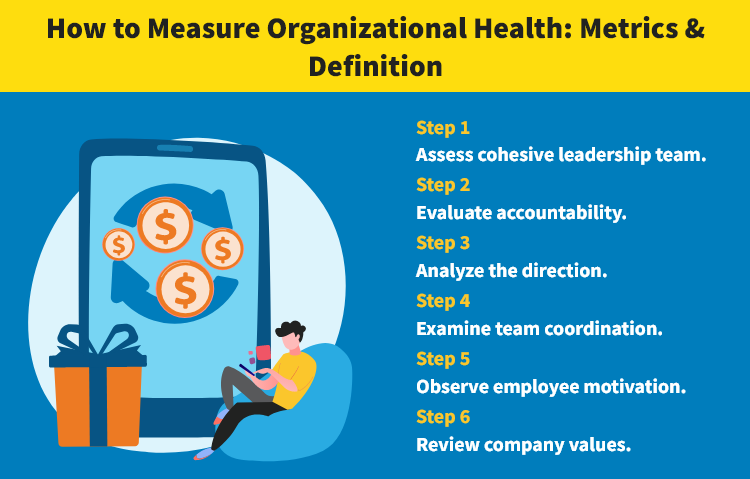
- Step 1. Assess cohesive leadership team.
- Step 2. Evaluate accountability.
- Step 3. Analyze the direction.
- Step 4. Examine team coordination.
- Step 5. Observe employee motivation.
- Step 6: Review company values.
Just like humans, an organization must be in optimal health to operate smoothly and effectively. This poses a question: what does organizational health actually mean, and how can we measure its vitality?

To give you an overview of what health in an organization indicates, this article will discuss its definition, disciplines, key organizational health metrics, tips to achieve a robust company, and how to measure its health.
What is organizational health?
Organizational health refers to a broad term that encompasses workplace culture, employee satisfaction, adaptability, and effectiveness of a company.
A healthy organization can mean different things for every company. Some definitions portray organizational health as the ability of a workplace to cope with changing business environments, achieve sustainable growth, and effectively operate despite business challenges.
There are three key aspects that make up an organizational health: the commitment of the team to achieve its vision and goals, its organizational performance and execution of business strategy, and its innovation through time.
Also, one of the main indicators of a healthy organization is when pay equity and transparency are promoted. Pay equity provides equal, competitive, and well-communicated pay for employees, which helps the workforce feel valued and motivated. Salary.com’s Pay Equity Software can help you with this.
What are four disciplines of organizational health?
Organizational health has four disciplines that guide business leaders in implementing a healthy team. Here is a list of them:
-
Establish a cohesive leadership team
The organization must be united with its goals and objectives. The members of healthy companies cultivate trust with one another, communicate through healthy conflicts, and practice accountability.
-
Promote clarity
The team must have an alignment in their core values and purpose. Organizational health assessment involves aspects like the nature of the work, the roles and responsibilities, strategic planning to succeed, and business priorities.
-
Reiterate clarity
To internalize cohesion and create clarity within the team, it must be communicated repeatedly and constantly. Team leaders take the role of continuously reminding everyone of their priorities, objectives, and values.
-
Strengthen clarity
Systems must be in place to ensure the effectiveness of a healthy organization. This includes building strategies for talent acquisition, performance management, recognition and reward programs, compensation, and other engagement initiatives.
What are organizational health metrics?
To give a representation of healthy or unhealthy organizations, organizational health metrics are established. Organizational health assessments are done through these different HR metrics, which can provide patterns and trends for data-driven decisions and strategies.

Here are the organizational health metrics that you can use to evaluate the health of your team:
-
Employee engagement
This measures the involvement and enjoyment of employees in the workplace. Engaged employees tend to have strong relationships with colleagues and leaders, show interest in career growth, and are more productive in their roles.
-
Employee well-being
This indicates workers’ happiness, health, and morale at work. If an organization has good employee well-being, it positively affects the environment, reflecting more rational and balanced decision-making.
-
Employee net promoter score (eNPS)
ENPS shows how employees are likely to recommend the company to others. A higher score means that the organization has a healthy system that maintains its success and talent management. A lower score indicates underlying issues that must be addressed.
-
Turnover rate
The employee turnover rate indicates employees leaving the organization. Satisfied employees tend to stay in the company, so if more people are departing, it can mean poor health for the organization.
-
Absenteeism rate
Absenteeism rate measures the absences of employees. If these absences were more frequent, it might indicate a burnout workforce or an unfulfilling job. A healthy organization keeps its employees engaged. Otherwise, it can mean potential issues.
-
Profitability
Profitability may not be the best indicator of a healthy organization, but financial performance is part of any business objectives. A profitable company can provide competitive resources for its people, so it contributes to the overall adaptability of the entire organization.
-
Job satisfaction
Job satisfaction is an outcome of good company values, robust pay and benefits, effective communication, and continuous learning opportunities. If there is a decline in fulfillment in the workplace, the company will have to improve its health and system.
-
New hire fail rate
The new hire fail rate measures how many new hires leave the company within a timeframe. A higher rate indicates the organization is not experiencing a return after investing in recruitment resources.
-
Organizational capabilities
Some of the organizational capabilities include leadership performance, talent, culture, and innovation. They help organizations achieve work, implement strategies, and provide customer satisfaction.
-
Workplace culture
A good company culture reflects healthy organization. It boosts teamwork and collaboration, encourages creativity and innovation, and attracts and retains top talents.
-
Organizational health index
This is a benchmark that measures the overall health of an organization. It evaluates different facets like leadership, employee experience, learning and innovation, and capabilities.
-
Pay equity
Pay equity measures the fairness of an organization’s salary structure. It determines employee salaries, helps eliminate biases in compensation, and encourages equitable pay regardless of race, gender, age, etc.
One way to assess the health of your organization is by determining pay gaps in your compensation structure. Through Pay Gap Assessment, you can analyze various factors that influence pay disparities, evaluate salary practices, and align business goals with fair employee compensation.
Why is organizational health important?
Good organizational health is important because it invests in the welfare of the workplace and its people. Despite business challenges, a healthy organization ensures good employee experience and commitment to the vision and goals of the company.
Here are other reasons why good results in organizational health metrics is important:
It creates a positive working environment, encouraging productivity, satisfaction, and morale.
It remains competitive against external job markets and achieves industry benchmarks and standards.
It promotes innovation, teamwork, and collaboration through open communication and regular feedback.
It results in high retention rates and low turnover rates.
It empowers sustainable career development and professional growth for employees.
It establishes diversity, equity, and inclusion initiatives that make every individual feel valued and respected.
It offers fair and competitive compensation packages that motivate the workforce.
How do you measure organizational health?
Technically, we can measure how healthy a company is by using the organizational health metrics we discussed above. They provide quantitative and qualitative data points that improve organizational health assessment, track progress, and evaluate areas of improvement.
Additionally, there is another way to measure how robust the workplace culture is, and it is by dissecting the most important aspects that contribute to a company’s health. Here are 6 steps to do this:
-
Step 1: Assess cohesive leadership team
Leadership is a vital factor as it serves as a role model for honesty, integrity, productivity, and overall behavior of the team. If they can motivate their members to achieve the same goals in a collective culture, then that is a good sign that the workplace is sound and agile.
-
Step 2: Evaluate accountability
An accountable workforce knows its roles and responsibilities in achieving organizational success. Low accountability can mean that goals and expectations are not clearly communicated, which leads to inefficiencies. With proper accountability, there is an even distribution of work and ownership of job performance, reflecting a healthy organization.
-
Step 3: Analyze the direction
Having an established direction in the workplace gives employees a comprehensive understanding of the processes and workflows to accomplish set goals. It empowers the workforce to work independently, exert the right skills needed, and be intentional with their productivity.
-
Step 4: Examine team coordination
Good team coordination means open communication between team members, even distribution of work, encouragement of innovative ideas, and helping each other out. Teamwork despite hiccups means that the organization has a flexible workforce that is prepared to effectively operate and cope with changes.
-
Step 5: Observe employee motivation
If employees are well-motivated, show enthusiasm at work, and are willing to dedicate energy to fulfilling team objectives, then that is a sign of a healthy workplace. Another indication is when there are learning opportunities to professionally grow and recognition programs that acknowledge the valuable contributions of high-performance workers.
-
Step 6: Review company values
The key elements of healthy organizational values are shared vision between the company and its people, transparency and trust between key stakeholders, open collaboration and communication, promotion of employee well-being, continuous learning and development, innovation, profitability, sustainability, flexibility, and equity.
A crucial step to measure organizational health is through Pay Equity Audit & Certification. This systematic process helps organizations conduct job analysis and pay gap assessment, remediate strategies with HR and executive team, and get certified for the commitment to fair pay.
Tips to have a healthy organization
Here are a few best practices you can use in your team to improve the health of your organization:
-
Use strengths-based management
Assess the strengths, skills, and capabilities of employees and assign them tasks that match their qualities. This allows the workforce to be intentional with work using their expertise and the company to increase productivity.
-
Gather employee feedback
The management still has a lot to learn when it comes to talents and organizational culture, so it is best to solicit ideas, concerns, and suggestions from the employees themselves. This can be done in many ways, like frequent feedback and surveys.
-
Promote diversity and inclusion
A healthy organization does not impose biases. It caters to all unique perspectives and backgrounds and creates a safe and transparent workplace, where individuals are valued and respected.

To maintain a robust organization that achieves organizational health metrics, assure your workforce and stakeholders that your company believes in fair and equitable pay treatment and live by it. Achieve consistent communication, pay transparency, and healthy organization through Pay Equity.
Insights You Need to Get It Right