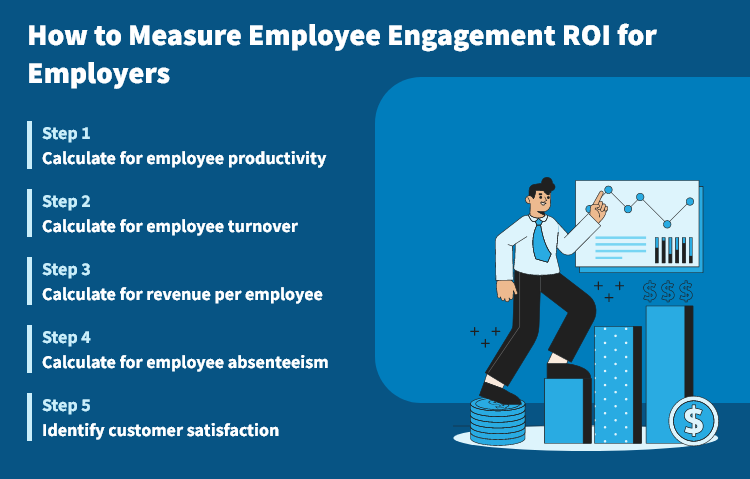
How to Measure Employee Engagement ROI for Employers

- Step 1: Calculate for employee productivity
- Step 2: Calculate for employee turnover
- Step 3: Calculate for revenue per employee
- Step 4: Calculate for employee absenteeism
- Step 5: Identify customer satisfaction
Companies who consistently reward their employees are not only 20% more likely to have better profits, but also enjoy having 17% more engaged employees. This proves that nowadays, treating employees like they’re valuable resources and valuing employee satisfaction is the secret sauce companies need to success.
These are called employee engagement ROI, and these can help companies know which direction to take in their wellness initiatives on top of many other factors. That said, employee ROIs can bring more to the company than just the advantages mentioned above, and learning how to measure it can help them save money in the long run.
Continue reading to learn more about employee engagement ROI, what employee engagement programs can do for companies, the factors that should be considered before creating one, as well as how companies can measure it to make better decisions moving forward.
What is employee engagement ROI?
Employee engagement ROI is defined as the benefits that a company can receive from their employees after investing in their employees’ wellness campaigns. It can range from financial advantages like an increase in revenue to non-financial benefits like increased employee engagement and reduced absenteeism.
Employee experience ROI also helps provide companies with a rough idea of their current company culture and helps them decide on the steps they need to take to boost it further. These can also give them a rough estimation of what they can do to elevate their employee wellness programs as well. After all, engaged employees tend to perform better, help create a more productive workforce, and contribute more to the company's success.
Having a robust pay practice set can help elevate the initial employee ROI, but companies will have to invest more money if they want cost savings in the program.
What is the ideal engagement ROI for employees?
Ideally, companies should reach for an employee engagement ROI of 60 to 70%. This number ensures that the vast majority of employees are satisfied with their current employers, and they can function well in their current working situation.
Keep in mind that the employee ROI can see a significant increase or decrease depending on the size of the company. Additionally, several factors like turnover, lower compensation without matching it to competitors, and absenteeism among many other factors can drastically lower a company’s employee experience ROI.
Factors that affect employee engagement ROI
Listed below are some factors that can directly – or indirectly - affect a company’s employee engagement ROI.
-
Compensation
Compensation is one of the biggest drivers of employee ROIs. A good compensation plan cannot just positively impact a company’s hiring practices but also boost employee morale, especially if they’re paid competitively.
-
Company culture
A positive workplace culture where work is valued and where positive employee recognition is the norm sees better employee engagement overall, on top of boosting employee feedback. Companies that consistently reward professional development also see better numbers in their employee ROI.
-
Flexibility
Whether it’s a flexible working environment or flexible hours, companies adding flexibility into their working environments can greatly increase productivity on top of boosting their employee ROI.

What are the formulas for employee engagement ROI?
To acquire an employee engagement ROI, all companies have to do is divide the profits generated from engagement initiatives by how much it costs. However, keep in mind that engagement initiatives also provide other measurable returns, like the factors mentioned above.
To put that into practice, let us assume that company A has recently upscaled and has reached 500 employees, and has spent $100,000 on luxury retreats for its employees. That same year, they saw a net profit of $4,446,045.67 after they fully encouraged their employees to utilize their wellness package.
Keep in mind that on average, their net profit averaged $1,262,954.43 in the previous years.
Thus, the formula for employee engagement ROI for company A for one month would look like the figure below:
$4,446,046.67 (net profit after the engagement initiative has been implemented) / $100,000 (cost of engagement initiative) = 44.460
Though the result is below the target that companies should reach, it still managed to provide value since they managed to almost double their net profits from previous years.
How can the 4 pillars of management help with employee engagement ROI?
The 4 pillars of management (connection, meaning, impact, and appreciation) can positively help with employee experience ROI since it helps promote a more positive and productive working environment. This, in turn, can help reduce turnover rates on top of helping increase customer satisfaction in the long run.
How to measure employee engagement ROI
Below are the steps that employers can take to measure and improve employee engagement ROI, divided by situation.
Let us use the same company A with 500 employees from above for brevity. Additionally, let us assume that there are an average of 51 absences per month, and 60 employees have left the company in the same year. They also have a monthly quota of 10 projects per month, all of which has been achieved for a total of 120 projects in the same month.
-
Step 1: Calculate for employee productivity
Companies should calculate employee productivity to properly identify the number of disengaged employees, as well as to let them know what steps they can take to improve employee engagement. To calculate employee productivity, companies can use the formula listed below:

Productivity = output / input x 100
Thus, employee productivity for company A would be:
100 (output) / 100 (input) x 100 = 100%
The average employee productivity rate that companies should strive for hovers around the 70% - 80% mark. Thus, a yearly average of 100% is stellar, especially for a medium-sized company with 500 employees.
-
Step 2: Calculate for employee turnover
Next, calculate employee turnover. Identifying this can help companies know what they can improve with their employee engagement initiatives to reduce the number of employees leaving. The formula to calculate it would look similar to the figure below:
Employee turnover = number of employees that left the company / number of current employees x 100
The employee turnover for company A would be:
60 (number of employees that left the company) / 500 (number of current employees) x 100 = 12%
Though the number for company A is slightly bigger than the ideal employee turnover rate, it is still a good number, especially when considering that company A has 500 employees since it’s considered a big company.
-
Step 3: Calculate for revenue per employee
Afterwards, the next step is to calculate revenue per employee, the formula of which can be seen below. Calculating this lets a company know what else they can do to help gauge employee sentiment, how to boost employee engagement ROI, and take the measures needed to improve it further.
Company’s total revenue / number of employees
Thus, the revenue per employee for company A would look similar to the figure below:
$4,446,045.67 (company’s total revenue) / 500 (number of employees) = 8,892.09
Though relatively small for companies of the same size, the revenue per employee for company A has only recently reached 500 employees.
-
Step 4: Calculate for employee absenteeism
Next, calculate for overall employee absenteeism. Identifying this number allows companies to have a better view of what the company lacks in engagement strategies for their employees. Thus, the formula for employee absenteeism will look like the figure below:
Number of total absences / number of workdays in a year
The employee absenteeism for company A is:
612 (average number of absences in a month x 12) / 260 (number of workdays in a year) = 2.35
Though number is relatively large for a company with 500 employees, 2.35 is still a relatively good number as the average absenteeism rate for the United States is 1.5.

-
Step 5: Identify customer satisfaction
Lastly, companies should identify their customer satisfaction rate. This can mostly be acquired by using customer surveys for the most part, but companies should target an average of 75 to 85%. Generally, we aim for higher customer satisfaction as improved customer satisfaction helps companies gain better financial impact in the long run.
Yes, initially utilizing employee engagement efforts and identifying the ROI of employee engagement initially costs a lot. But much like everything else in business, think of it as an investment - less disengaged employees mean better business performance. And better business performance translates to the organization's success in the long run – top that with great compensation practices, and companies can witness their profit margin ratio skyrocket.
Insights You Need to Get It Right